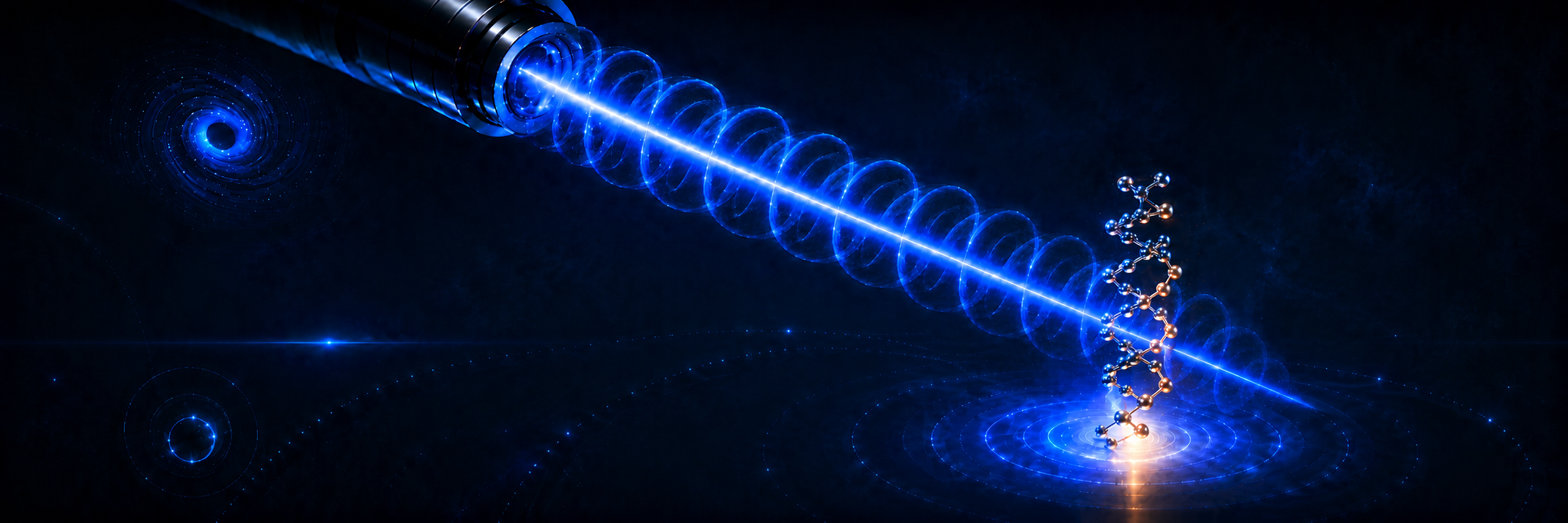
If we could precisely control, identify, and selectively distinguish the quantum-mechanical properties of matter using light—and, conversely, control light by harnessing the quantum-mechanical properties of matter—the scope of existing technologies might extend far beyond the limits of our present imagination. Moreover, the pursuit of such capabilities should lead to a deeper understanding of the fundamental mechanisms underlying light–matter interactions.
The quantum-mechanical properties of matter are embodied in structures on the nanometre scale. A nanometre is one billionth of a metre. To appreciate this scale, if one metre were enlarged to the diameter of the Earth, one nanometre would be comparable in size to a marble. Using the principles of quantum mechanics, we investigate how light and nanoscale matter interact with one another. We also seek to elucidate how these interactions can give rise to novel and intriguing functionalities.
Read more
Our particular focus lies in the reciprocal nature of the interaction between light and nanoscale matter: rather than acting in only one direction, each continuously influences the other. Moreover, even within minute material systems and tightly confined spaces, both light and matter possess rich spatial structures. Their intricate interplay can therefore give rise to entirely new physical phenomena. Our goal is to investigate theoretically the extreme regimes emerging from this interplay, thereby deepening our understanding of fundamental physics while opening new possibilities for future technologies.
For example, we have demonstrated the potential of thermal-free photonics, in which excitation energy that would ordinarily be dissipated as heat is instead emitted as light on a timescale faster than that of nonradiative relaxation. We have also proposed a mechanism capable of optically distinguishing a difference at the level of a single atom within a nanoparticle composed of several hundred thousand atoms, thereby enabling the selective isolation of only those particles exhibiting a desired emission performance. Through collaborations with numerous experimental groups, these theoretical studies have progressed toward experimental verification.
For specific examples of the novel physical phenomena arising from the interplay between light and nanoscale matter, as well as the functionalities they enable, please explore the topics below.
Research Topics
Optical-Force-Driven Sorting by Quantum Properties (In preparation)
By harnessing optical forces, we aim to establish a new platform for nanomaterial fabrication that directly identifies the distinct quantum-mechanical characteristics of nanoparticles—such as quantum dots and fluorescent nanodiamonds—from their motion, and subsequently enables their selective separation, enrichment, and recovery.
Coherence-Driven Plasmonics: Hot Carriers for Efficient Energy Conversion (In Preparation)
We investigate how plasmons excited in metallic nanostructures generate high-energy electrons and holes—known as hot carriers—and thereby convert optical energy into electrical or chemical energy. Our aim is to elucidate theoretically the quantum coherence and interference of plasmons that govern these processes, and to propose efficient strategies for generating and utilizing hot carriers by harnessing such interference effects.
Nonlocal Theory of Near-Field Nanospectroscopy (Under preparation)
We analyze tip-enhanced Raman scattering and photoluminescence, as well as photoinduced force microscopy, within the framework of nonlocal response theory. By elucidating the interaction between optical near fields and the spatially extended quantum states of molecules and quantum dots, we seek to clarify the mechanisms that enable nanoscale imaging of luminescent, Raman, mechanical-force, and chiral responses.
Optical Vortices and Chiral Matter (Under preparation)
We investigate the interaction between optical vortices—twisted light—and chiral matter possessing right- or left-handed structures. Our aim is to elucidate theoretically how the chirality carried by an optical vortex, together with its angular momentum, is transferred to matter and gives rise to optical responses that distinguish between the two handednesses.